

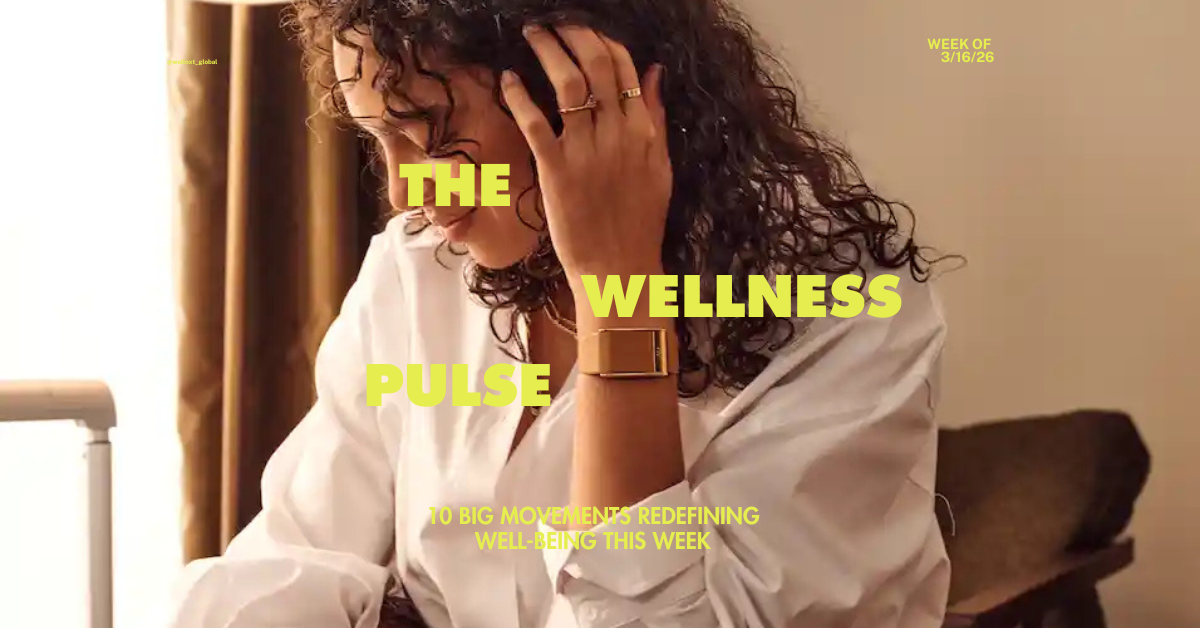
Image courtesy of Whoop
This week’s wellness headlines highlight a powerful shift: women’s health, longevity science, and relationship wellbeing are becoming central pillars of the next wellness economy.
From blood biomarker testing and telehealth longevity platforms to global running events designed for women and AI-powered couples wellness, the industry is expanding beyond fitness and self-care into whole-life wellbeing systems.
Here are the 10 most important wellness signals shaping the week.
1) WHOOP Launches Women’s Health Blood Test Panel
Wearable performance company WHOOP announced a new women’s health blood biomarker panel, expanding its Advanced Labs testing platform with 11 female-specific biomarkers tied to hormonal health, thyroid function, nutrient status, and perimenopause. The company is also integrating menstrual cycle insights into its app.
Why it matters: Wearables are evolving into diagnostic platforms. When biometric tracking merges with lab testing and AI insights, devices shift from fitness accessories to personal health operating systems.
📍 Source: Tech Crunch
2) AI Couples Wellness Platform Arya Raises $21M
Relationship-wellness startup Arya secured $21 million in growth financing to expand its AI-powered couples wellness platform. The platform blends relationship coaching, mental health tools, and guided communication programs designed to improve long-term relationship health.
Why it matters: Wellness is expanding beyond the individual. Investors are beginning to treat relationship health as a core wellness category, recognizing that partnership dynamics significantly influence mental health, longevity, and overall wellbeing.
📍 Source: Athletech News
3) Wisp Launches Women-Focused Longevity Suite
Telehealth company Wisp debuted a new Healthy Aging vertical focused on women’s longevity. The offering includes hormone optimization support, sexual health care, metabolic health services, and preventative diagnostics.
Why it matters: Women’s health is rapidly evolving from reactive care to lifelong longevity management. Companies that build integrated platforms for hormonal, metabolic, and sexual health are positioning themselves at the center of the next wave of preventative healthcare.
📍 Source: BusinessWire
4) Precision Wellness Platforms Gain Investment
Health tech company Radicle Science secured new funding to expand its AI-driven “Proof-as-a-Service” platform, which runs large-scale clinical trials on wellness products to generate validated health claims.
Why it matters: As the wellness industry grows, scientific validation is becoming a competitive advantage. Brands that can prove efficacy through real clinical data will increasingly outperform companies relying on marketing claims.
📍 Source: Nutrition Insight

5) Nike Launches Global “After Dark Tour” Race Series Built for Women
Nike announced the After Dark Tour, a new global women-focused race series launching in 2026 across major cities including Sydney, Shanghai, Seoul, Mumbai, Los Angeles, and Mexico City. The event series is designed specifically for women runners and will include community runs, nighttime race experiences, and training resources supported by Nike’s coaching ecosystem.
Why it matters: Women’s sports participation is surging globally, and brands are responding by building purpose-designed ecosystems rather than one-off campaigns. Nike’s investment signals that women’s running communities represent not just a participation trend, but a major growth engine for the future of sport and wellness.
📍 Source: Nike
6) GLP-1s May Open a New Frontier in Addiction Treatment
A growing body of research is pointing to GLP-1 medications as a possible tool in addiction care. New reporting around a large BMJ study found that GLP-1 drugs were associated with lower risk of developing substance use disorders across alcohol, cannabis, cocaine, nicotine, and opioids among patients with diabetes. In patients with existing substance use disorders, GLP-1 use was also linked to fewer emergency visits, hospitalizations, overdoses, and deaths.
Why it matters: This is a major signal that GLP-1s may have relevance far beyond weight loss and metabolic health. If future clinical trials confirm these findings, the category could expand into craving regulation, addiction treatment, and broader brain-reward health — reshaping how wellness, medicine, and behavior change
📍 Source: CNN
7) Universal Health Services Strikes an $835 Million Deal for Talkspace
Universal Health Services said it will acquire online therapy provider Talkspace in a deal valued at about $835 million, citing rising demand for behavioral health services. Reuters reports the move reflects continued consolidation and strategic investment in virtual mental health care.
Why it matters: Mental health is no longer peripheral to wellness strategy. This deal shows that behavioral health is being treated as a core growth area — and that virtual care remains central to how large systems plan to scale access.
📍 Source: Reuters
8) Oura Acquires Doublepoint to Push Wearables Toward Gesture-Based AI
Oura acquired Doublepoint, a startup specializing in gesture-recognition technology. TechCrunch reports the move could help Oura bring more natural controls into wearable experiences, while Oura said the acquisition supports its push into AI-driven, human-centered innovation.
Why it matters: Wearables are becoming more ambient, intuitive, and embedded in everyday life. This points toward a future where wellness tech is not just something you check — it is something that works more seamlessly in the background of how you move and live.
📍 Source: YAHOO! News UK

9) Eli Lilly Plans a $3 Billion China Investment Tied to Obesity and Diabetes Growth
Eli Lilly plans to invest $3 billion in China over the next decade to boost production capacity tied to its diabetes and obesity portfolio, including oral GLP-1 candidate orforglipron.
Why it matters:This reinforces how central metabolic health has become to the future of healthcare and wellness. When major pharma players are making multibillion-dollar bets on obesity and diabetes treatment capacity, it signals the scale of the market ahead.
📍 Source: Bloomberg
10) Do You Really Need a Water Filter?
A new report highlighted by the Associated Press explains how more households are turning to water filtration systems as concerns about PFAS—often called “forever chemicals”—continue to grow in drinking water across the United States. PFAS have been linked to a range of potential health risks, and experts say certain filters, including reverse osmosis and activated carbon systems, can significantly reduce their presence in tap water.
Why it matters:Water quality is becoming a core pillar of everyday wellness. As awareness of environmental health risks increases, consumers are looking for practical solutions—like home filtration—to protect long-term health and reduce exposure to contaminants.
📍 Source: AP News
WISe Takeaway
The strongest theme this week is integration. Women’s health is becoming more data-driven. Mental health is attracting bigger institutional bets. GLP-1s are stretching across obesity, addiction, and metabolic care. And wearables are evolving from trackers into more intelligent health interfaces.
In other words: wellness is continuing to mature from a fragmented consumer category into a more connected system of diagnostics, treatment, prevention, and lived experience. The brands, platforms, and institutions that win next will be the ones that understand wellness not as a niche, but as infrastructure.
Follow WISe Wellness Guild on LinkedIn andInstagram for next week’s Wellness Pulse.
Is your brand set up for success in the wellness industry? Take our WISe Brand Blueprint Assessment or schedule a free discovery call to get started.
📌 Follow WISe Wellness Guild on LinkedIn and Instagram for next week’s Wellness Pulse.